
Hawk and Squirrel
On fleeting life, sacred attention, and willing the one thing

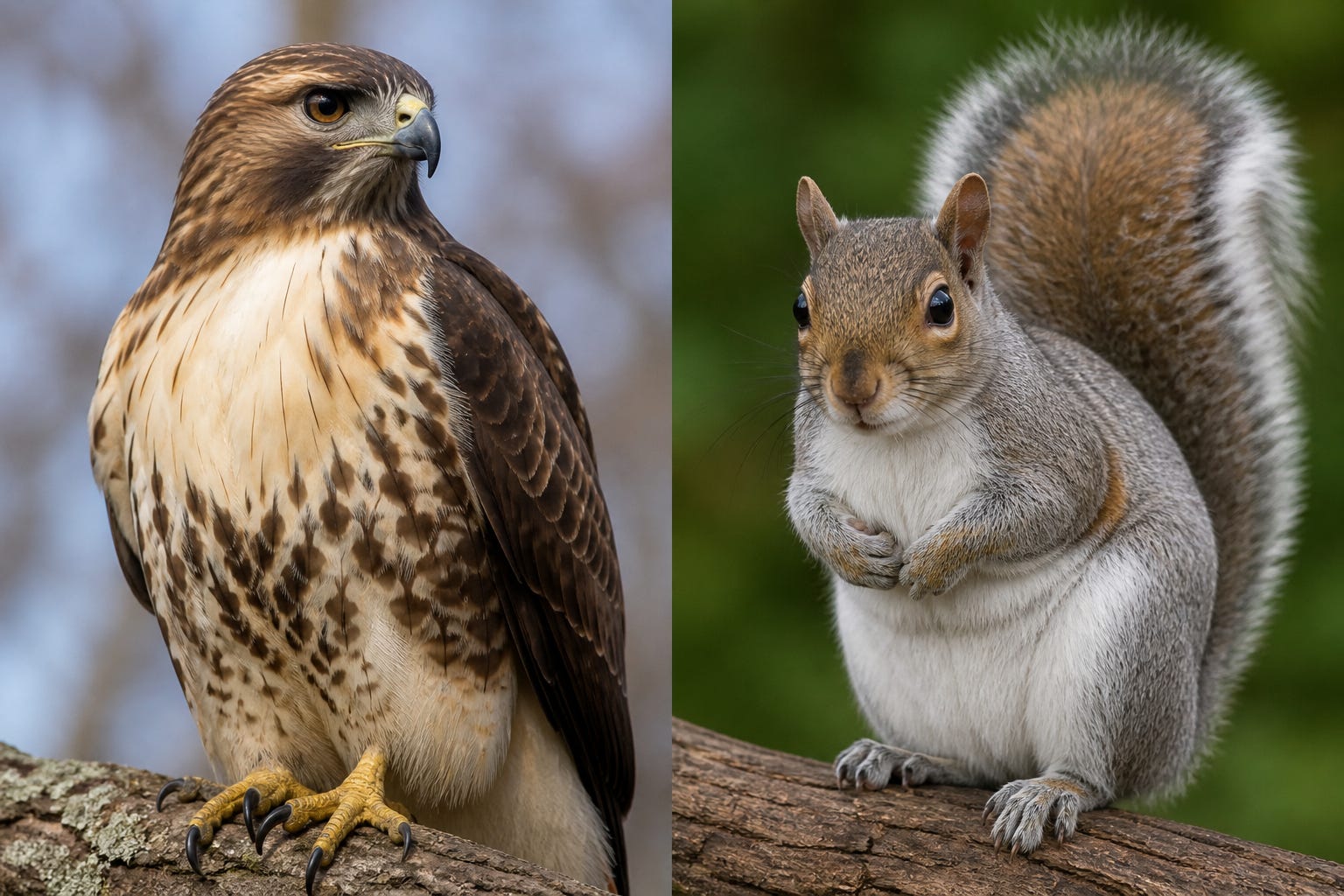
Walking out of my office, I saw it.
A small squirrel—light, quick, alive—darting across the grass beside the sidewalk. And then, in a flash, a hawk swooped down, seized it, and was gone. I stood there, watching as it flew off, the bushy tail of that little squirrel hanging from its talons.
It was over in seconds.
Now, I understand how the world works. Hawks have to eat. The natural order has its rhythms—predator and prey, the food chain, the cycle of life and death. None of this was surprising.
And yet, something lingered—a residue.
The next day, I sat with a family grieving the loss of a wife and mother—tragic, sudden, disorienting. Again, nothing surprising. Death is not new to us. We don’t wake up one morning shocked that mortality is still a thing.
And yet every time, it feels like a betrayal. There is something in us that insists: This is not how it’s supposed to be.
What’s strange is that nothing in our lived experience actually supports that claim. We have always lived in a world where things die—where animals consume one another, where time moves forward without pause. And yet, when death comes—whether to a squirrel in the grass or to someone we love—it leaves behind that same residue.
But as I reflected on that moment, I noticed something else. I instinctively identified with the squirrel. Not the hawk. Why?
Why does my imagination immediately create a villain and a victim? Why do I align myself with the one who suffers and not the one who survives?
The hawk was not malicious. It had no vendetta. It did not hate the squirrel. It simply acted according to its nature. And yet, in my mind, it became the antagonist.
Perhaps that instinct to label reveals something about us—about how we narrate the world, how quickly we simplify it into binaries: good and evil, victim and villain, right and wrong. But we quickly realize that life rarely cooperates with such simplicity.
Side note, dear reader, there are moments when I tell myself: Jason, not everything needs to mean something.
But I refuse to live that way. To be human is to make meaning—to search for clues of the divine embedded in the ordinary. And as I stood there watching that hawk disappear into the sky, one phrase kept echoing in my mind: Life is fleeting.
We all know this—conceptually. We say it. We preach it. We say we believe it. But we don’t live like it.
And as that memory glided into the next day, the same residue remained as I listened to that grieving family. I asked them not to rush into logistics for a service. Instead, I invited stories.
And they told them.
Stories of a woman who ran spontaneously, walked to neighboring towns, carried home antique tables, dismantled objects just to understand how they worked. A woman of curiosity. Of intensity. Of singular focus.
At first glance, her life might seem scattered. But step back—and you see something else. You see movement. Direction. A kind of wind-filled journey. You see someone who, in the words of Søren Kierkegaard, understood that: To love is to will the one thing.
She willed something (multiple somethings). But each thing got her singular focus in that moment. Her eclectic life was not hesitant. Not fearful. Not held back by the illusion of endless tomorrows.
These are the people with substance—the ones who carry weight in our lives. Oddly, we often talk about leadership in business terms—strategy, metrics, outcomes. But real leadership is simpler. It is influence. Leadership isn’t just for CEOs; it’s for the ragamuffins who tell stories and invite us to listen.
You can influence through coercion—and people will comply, briefly. But when you’re gone, so is your impact. Or you can influence through love, trust, and intimacy. And when you’re gone, people continue. They say: We have to keep going the way they were going.
That is legacy.
This story is not about choosing sides. It’s about recognizing ourselves in both a squirrel and a hawk. We are always the squirrel—vulnerable, fleeting, not entitled to tomorrow. And we are invited to be the hawk—called to act, to seize opportunity, to move when the moment presents itself.
To the squirrel in us: Do not assume you have time.
To the hawk in us: Do not hesitate when the moment comes.
Because opportunities are not unlimited, and neither are we.
When you think about it, the very idea of “the present” makes you wonder if it really exists. “Fleeting” is our simplistic way of noting that the moment we name the present, it’s already gone. We are suspended—always—between past and future.
Perhaps that’s what the hawk and the squirrel reveal. The squirrel represents the past—the path that brought us here, the accumulated movement of our lives. The hawk represents the future—the call, the opportunity, the moment yet to come that asks something of us.
And we live in the tension between them that we receive as the present.
Somewhere in the middle of all of this—hawks, squirrels, grief, memory—I think of my friend Sharon. She would not have reduced that moment to villain and victim. She would have been curious. Attentive. Open to the sacred rhythm embedded within it.
We live in a world of noise: Artificial intelligence. Geopolitics. War and rumors of war. And yet, what a gift it is—to step outside. To put your feet in the grass. To see. To hear. To taste. To smell. To touch. To experience, even briefly, the harmony of the senses singing back to their Creator.
We have one life, and it would be a tragedy to move through most of it without ever pausing long enough to notice—the hawk, the squirrel, the breath in our lungs, and the presence of God in the ordinary.