
Look Up
What a Juvenile Owl Taught Me About Attention

We pay very little attention to where our eyes go. Most of us move through life looking in one of three directions. We look forward, toward wherever we think we are going. We look down, making sure we do not stumble over obstacles or searching for something we have lost. Or we look backward, trying to understand where we have been or what still haunts us from behind.
Forward. Down. Backward.
Where are we going? Where are we? Where have we been? Rarely do we look up.
Earlier this week, while walking near the woods behind my home, I heard the shrieking call of a juvenile barred owl. As I drew closer, I realized there was not just one owl but several fledglings perched among the branches, calling back and forth to one another and announcing their location to their mother. Like children everywhere, they seemed eager to be found and fed.
If you have never heard a young barred owl at dusk, the sound is difficult to describe. It resembles a cat's hiss combined with a piercing cry that seems to end in a question mark. It is eerie, almost unsettling. Yet it is precisely that strange cry that stopped me in my tracks.
It invited me to do something I rarely do. It invited me to look up.
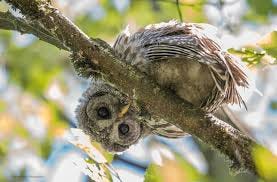
As I stood at the edge of the woods and lifted my gaze into the canopy, an entirely different world revealed itself. Leaves glowed with the light of the setting sun. Birds darted between branches. A squirrel leapt effortlessly through the treetops. And hidden among the leaves sat a young owl watching me as carefully as I was watching it.
The great irony is that so much beauty exists directly above our heads, unnoticed because our eyes are fixed on destinations, schedules, screens, and responsibilities. Looking up interrupts all of that. It becomes difficult to march forward with determination when your attention has been captured by wonder.
Even more, looking up invites listening.
The owl would not easily reveal itself. I had to stop. I had to listen carefully. I had to trace the direction of the cry and search patiently through the branches. The owl made me work for the encounter.
Perhaps that is why owls have long been associated with wisdom. Wisdom is rarely handed to us. It comes wrapped in mystery. It asks us to seek before we find.
We often want God, beauty, and truth to arrive as conveniently as a Tootsie Roll Pop commercial, with immediate answers and quick rewards. The owl offers no such shortcut. Instead, it hides in the shadows and invites patient attention.
As I finally spotted one fledgling perched overhead, I made the mistake of looking directly into its eyes. In the animal kingdom, direct eye contact can be a sign of predation or dominance. Yet something remarkable happened. When I shifted, the owl shifted. When I leaned one direction, it leaned the other. For a brief moment, there was a curious exchange between two creatures trying to understand one another.
How rare it is to encounter something in the natural world that feels so intelligent, so present, so aware. And I found myself wondering: as I looked up at the owl, was the owl also looking down at me with equal curiosity?
Americans are, in many ways, a colonizing people. We are trained to master, manage, improve, and conquer. We move through forests thinking about trails to clear and destinations to reach. We rarely stop to consider the world that already exists apart from our plans. Then a shriek from the darkness reminds us that the world is not nearly as tame as we imagine.
For most of human history, forests were not places of recreation but places of uncertainty. They represented mystery, danger, and the unknown. We have become comfortable because our lawns are manicured and our roads are paved. Yet when we step into the woods and look up, the roles reverse.
Suddenly we are no longer the masters of the landscape. We are the field mice wandering through the great mansion of the forest. The owl remains perfectly at home. There is something humbling about that realization.
Standing beneath the tree, I found myself appreciating not merely the owl but my own limitations. For all our technology, all our engineering, all our accomplishments, we have never replicated the silent elegance of owl flight. Military researchers have studied owl feathers because of their extraordinary ability to reduce sound. When an owl passes overhead, it often startles you precisely because you never heard it coming.
That is not a flaw. That is grace.
Perhaps this is why encounters with wild beauty often feel almost supernatural. They expose the inadequacy of our categories. They awaken something dormant within us. They remind us that the world is larger, stranger, and more mysterious than we usually allow ourselves to believe.
As I sat watching that juvenile owl, I understood why so many cultures have associated these creatures with spiritual significance. The owl is contemplative. It watches. It waits. It refuses to hurry.
And perhaps what we call beauty is often the recognition of a deficiency within ourselves. When I find an owl beautiful, perhaps what I am really discovering is my own need for mystery. When I am drawn to transcendence, perhaps it is because I have become spiritually dehydrated. Just as the body thirsts for water, the soul thirsts for wonder.
I do not know what to do about most of the problems in our world. The world feels chaotic, complex, and increasingly beyond my control. But I know what happens when I walk to the edge of the woods.
I know what happens when I stop. I know what happens when I look up. There, at the edge of the forest, I find myself exactly where I am supposed to be.
Wendell Berry once wrote, "I come into the peace of wild things." The line has always struck me as ironic. We spend so much of our lives trying to tame the world, and yet peace often arrives through an encounter with something genuinely wild. A juvenile owl reminded me of that.
Thank you, little owl. Thank you for your shriek in the night. Thank you for making eye contact. Thank you for your friendship. Most of all, thank you for reminding me to look up.
For when I do, I often discover that God has been blessing me all along through gifts I never noticed because my eyes were fixed somewhere else. And sometimes those blessings arrive in the form of two large eyes looking back down from a tree.