
We Need a Renaissance
The Forgotten Prerequisite of Every Reformation

Every few years, it seems, someone announces that we are living through another Reformation. The argument is understandable. The center of Christianity has shifted dramatically away from Europe and North America toward Latin America, Africa, and parts of Asia. Long-standing institutions appear increasingly fragile. New technologies are transforming nearly every aspect of life. Political and cultural landscapes seem to be rearranging themselves before our eyes.
Years ago, in The Great Emergence (2008), Phyllis Tickle famously suggested that Christianity experiences a great upheaval roughly every five hundred years. The Protestant Reformation emerged about five centuries after the Great Schism. By her reckoning, our own moment represented another such turning point. Perhaps she was right.
Yet I increasingly wonder if we have misdiagnosed the moment. What if our primary challenge is not that we need another Reformation? What if we are actually living through something more akin to a new Dark Age?
The phrase “Dark Ages” is often misleading. Historians rightly remind us that the period following the collapse of the Western Roman Empire was not devoid of culture, learning, or innovation. Much was happening during those centuries.
Yet there was also a profound sense of dislocation. Political structures fractured. Borders shifted. Massive migrations of people transformed entire societies. Old assumptions about identity and belonging no longer held. The church struggled to understand how it should exist in a rapidly changing world. That sounds remarkably familiar.
Today, we inhabit an age defined by technological acceleration. We have reached the strange point in history where humanity is seriously discussing the existential threat posed by something humanity itself created.
Empires once thought to be permanent appear increasingly fragile. New powers are emerging. Global alliances are shifting. Artificial intelligence, algorithms, and digital systems are reshaping not only what we do but how we understand ourselves.
Like the early medieval world, we find ourselves struggling to maintain a coherent sense of collective identity amid forces larger than any individual can control. And yet there is surprisingly little genuinely new theological imagination emerging to meet the moment.
Conservatives continue to divide over increasingly precise doctrinal distinctions. Progressives continue to blur distinctions between orthodox belief and modern progress. Much of our energy is spent defending old positions rather than discerning new possibilities.
The challenge facing Christians today is not simply theological reform. It is learning how to live faithfully amid civilizational transition. We need something akin to a monastic or nomadic posture—a way of navigating changing cultural currents without losing our center.
One reason I find the Dark Ages analogy compelling is because of a troubling theological parallel. The medieval world often struggled with forms of dualism that elevated the spiritual while diminishing the material. The earthly was viewed as inferior. The body was suspect. Salvation was imagined primarily as escape.
Much of today’s technological imagination sounds surprisingly similar. Artificial intelligence promises transcendence from limitations. Efficiency becomes the highest virtue. Slowness, embodiment, locality, and dependence appear as problems to be solved rather than gifts to be received.
Work that takes time becomes inefficient. Relationships that require patience become obstacles. Human limitations become defects. The ideal increasingly appears as a kind of digital ascent into a frictionless cloud of optimization and productivity.
But Christians should be suspicious whenever humanity begins to imagine salvation as an escape from creatureliness. The question, then, cannot simply be what technology can do. The question is what kind of people technology is shaping us to become. As Paul reminds us, “Everything is permissible, but not everything is beneficial.” That is precisely the conversation we need today.
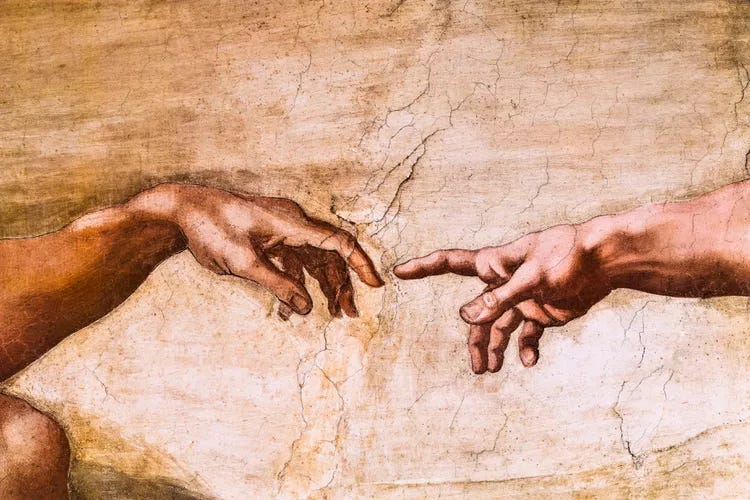
The Protestant Reformers did not emerge from a vacuum. The Reformation was made possible by something that came before it, the Renaissance. Before Europe could reform its theology, it had to recover its humanity.
The Renaissance renewed interest in the human person, the arts, beauty, creativity, language, and the possibilities of human flourishing. It recovered a sense of wonder regarding what it means to be human.
Certainly, the Renaissance had its own excesses. Every movement does. Yet it also created the conditions necessary for reform. Artists stretched the limits of imagination. Writers explored the depths of human experience. Scholars rediscovered ancient texts. Thinkers crossed intellectual and cultural boundaries.
Christian, Jewish, and Muslim scholars entered conversations that transformed the intellectual landscape of Europe. Mystics such as Francis of Assisi crossed borders and imagined new ways of inhabiting a divided world.
The Renaissance cultivated precisely the kind of theological anthropology that reform requires. It asked:
Who are human beings?
What are we for?
What does it mean to flourish?
How should we live together?
Only after those questions were revisited could meaningful reform occur.
What if the church’s primary task today is not reforming doctrines but recovering a robust vision of humanity? What if the real challenge before us is learning once again what it means to bear the image of God?
We need artists who can imagine new possibilities. We need writers who can articulate what it feels like to live in this moment. We need contemplatives who can see beyond the noise. We need theologians who can recover a vision of embodied life. We need communities that model friendship, presence, and fidelity in an age of distraction. We need a renewed theological anthropology capable of answering the fundamental questions technology cannot answer:
Who are we?
What are we for?
What kind of people should we become?
Without answering those questions, we have nothing meaningful to reform.
Perhaps the greatest danger of artificial intelligence is not that it will replace jobs. Nor the dystopian possibilities that fill our imaginations. Maybe the greater danger is that we no longer know whether AI bears our image or whether we increasingly bear its image.
We gather together at the altar of efficiency. We sacrifice presence for productivity. We confuse optimization with wisdom. And in doing so, we risk becoming less human.
The Renaissance confronted a similar question. Do we care about the human form? Do we believe embodied existence matters? Do we believe community, friendship, creativity, contemplation, and love are essential to human flourishing? Or are they merely inefficient obstacles to productivity?
Those are the questions before us now. And until we answer them, talk of Reformation may be premature. Before Reformation, we need Renaissance. Before we can reform the church, we must remember what it means to be human.